

Branding, wayfinding and signage
Making workplaces recognisable, inclusive and easy to navigate.
This guidance explains how to use consistent branding, signage, and wayfinding so staff, visitors, and partners can find their way confidently in government buildings.
Branding hierarchy
- Branding should follow the NZ Government brand hierarchy set by Te Kawa Mataaho.
- Primary branding expresses the New Zealand Government identity. Secondary (agency) branding is used to reflect agency identity.
- Consistent branding helps people more easily recognise, access and navigate government buildings, regardless of agency or location.
Early engagement and co-design
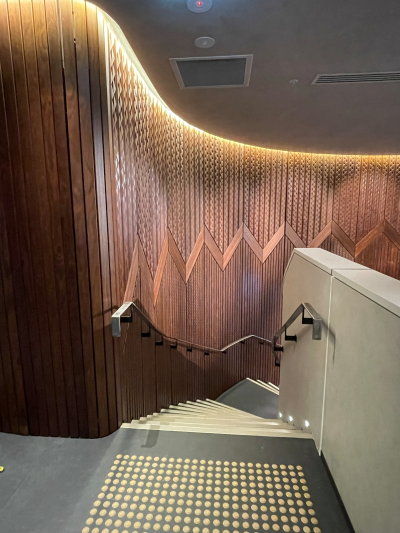
Korowai stair at Te Iho, Wellington. Designed by Len Hetet, Te Āti Awa, Taranaki Whānui.
- Plan to integrate cultural and place-based narrative early in the design process so this can shape the overall look and feel of the space and how it will be experienced.
- Early integration ensures this is authentic, meaningful, and able to influence the design beyond just wayfinding and signage.
- Any cultural narrative and design elements (visual or text) should be developed in partnership with mana whenua and cultural advisors. These elements must be endorsed, guided, and shaped by mana whenua, ensuring authenticity, correct dialect, appropriate representation, and respect for tikanga.
- Agencies should engage their internal Māori advisors early if co-design is in scope.
- Te Puni Kōkiri’s Te Kāhui Māngai (directory of Iwi and Māori organisations) is a useful resource to find basic information on iwi and hapū.
Directory of Iwi and Māori Organisations — Te Kāhui Māngai
Visual identity
- Avoid visual design themes solely based on your agency’s brand.
- Preference should be given to visual design that references local themes and narratives of place, such as:
- cultural integration and expression
- local history and whakapapa
- connection to community.
- Plan for artwork/taonga display, bilingual signage, and culturally relevant naming to ensure cultural narratives are integrated in a way that honours place, people, and identity.
Wayfinding and signage
- Signage should be simple, usable, and easy to understand – helping people understand the layout and find their way independently.
- Use colour with signage to differentiate floors and support navigation, especially around lift lobbies.
- Follow the three NZS 4121 signage functions: informative, directional, and locational. Access:
Standard NZS 4121:2001 — Building Performance - Apply bilingual signage in line with Te Puni Kōkiri and Te Taura Whiri guidance – incorporate correct dialects and cultural context.
Māori-English Bilingual Signage – a guide for best practice - Signage must support universal design by reducing sensory load and providing clear orientation cues.
- Provide Braille, tactile print, and large print signage in public facing areas.
- The building's street number must be clearly visible for accessibility and wayfinding.
Visual contrast and colour selection
- Strong visual contrast between walls, floors, doors, and other surfaces helps people with low vision navigate spaces safely and identify features and obstacles.
- Patterns should be selected carefully as they may affect depth perception, spatial awareness or visual overstimulation for some users.